Gaikiyoku: The Japanese Art of Air Bathing (The Sauna Phase You're Probably Skipping)
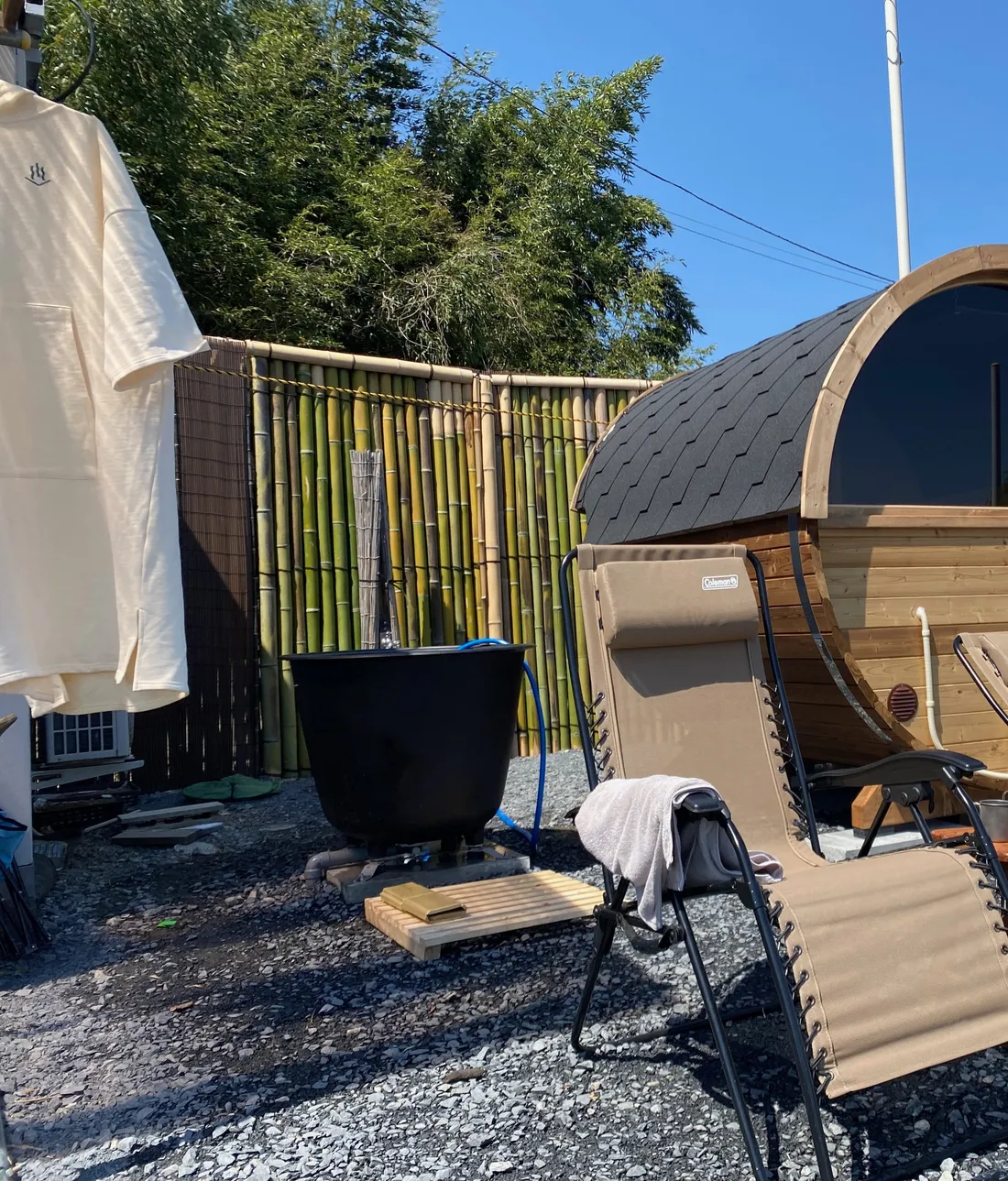
The short version: Gaikiyoku (外気浴) means “outdoor air bathing” — the rest phase after sauna and cold water, done outside, treated in Japanese sauna culture as the main event rather than the break between events. If your sauna routine ends with a quick sit on a bench before the next round, this article is about the phase you’re rushing. It’s where totonou — the deep-reset state — actually happens.
Bathing in air
The word choice is the whole philosophy. Japanese doesn’t call this phase “resting” or “cooling down” — it calls it bathing, in air, the way you’d bathe in water. Air is the medium. Your warmed, then chilled, then recovering skin is extraordinarily sensitive for those few minutes, and moving air across it produces a sensation you simply cannot get any other time.
That’s the Japanese insight: airflow is an active ingredient. A rest spot without moving air is like a bath without water.
The setup that made me understand it
My sauna sits on family land in the countryside, surrounded by open fields. Between rounds I lie back on a zero-gravity infinity chair, and the wind arrives across the crops with nothing to slow it down.
The first time everything aligned — 90°C rounds behind me, cold water still ringing on my skin, lying flat with countryside wind moving over me — I understood why the phase gets its own name. It isn’t a pause in the experience. It is the experience; the sauna and the plunge were the preparation. The full concept of totonou, explained.
Building a good gaikiyoku spot
You need surprisingly little, but each element earns its place:
- A chair you can go boneless in. Zero-gravity/infinity chairs are the Japanese sauna community’s default for a reason: legs up, spine supported, zero muscle engagement required. A regular chair keeps you subtly sitting; you want to be poured.
- Moving air. Natural breeze if your site has it. If it doesn’t, use a fan — a fan is not cheating; still air is. On rainy days we pitch a tarp and run an electric fan underneath, and those sessions rank among the best of the year. The full rainy-day setup.
- Something for your eyes to rest on. Sky, fields, trees. Our spot faces the vegetable garden — watching things grow while your body hums is its own kind of medicine. A wall works; a horizon works better.
- Silence, or close to it. This is the phase where conversation naturally stops. Protect that.
Total cost if you’re starting from nothing: one infinity chair (~$50–100) and maybe a fan. The cheapest component of any sauna setup, and the one that most transforms it.
How long, and what to actually do
Five to ten minutes minimum, and do nothing. Not phone-nothing. Actual nothing.
The totonou wave, when it comes, typically arrives one to two minutes in — a heaviness in the limbs, a tingling skin-hum, thoughts going quiet on their own. Stay past it. The mistake is treating the wave’s arrival as the signal to get up for the next round; let it finish speaking.
In winter, gaikiyoku gets short and sharp — a few minutes before the cold flips from pleasant to hostile. In summer, I’ve drifted at the edge of sleep out there. Both are correct.
The gaikiyoku mindset, exported
You don’t need rural Japan for this. You need: a place outside (balcony, backyard, even a garage with the door open), horizontal support, moving air, and the discipline to give the phase the time it deserves. Every element of my setup has a cheap, urban equivalent.
What doesn’t have an equivalent is skipping it. If you’ve been sauna-ing for years and totonou has never visited, I’d bet on the missing third phase before I’d bet on anything else.
The barrel, the cast-iron cold plunge, and the whole 3-year story: read it here.