My Little Barrel and I Are Happy Being Wrong Together: The Finnish Case Against Barrel Saunas, Taken Seriously
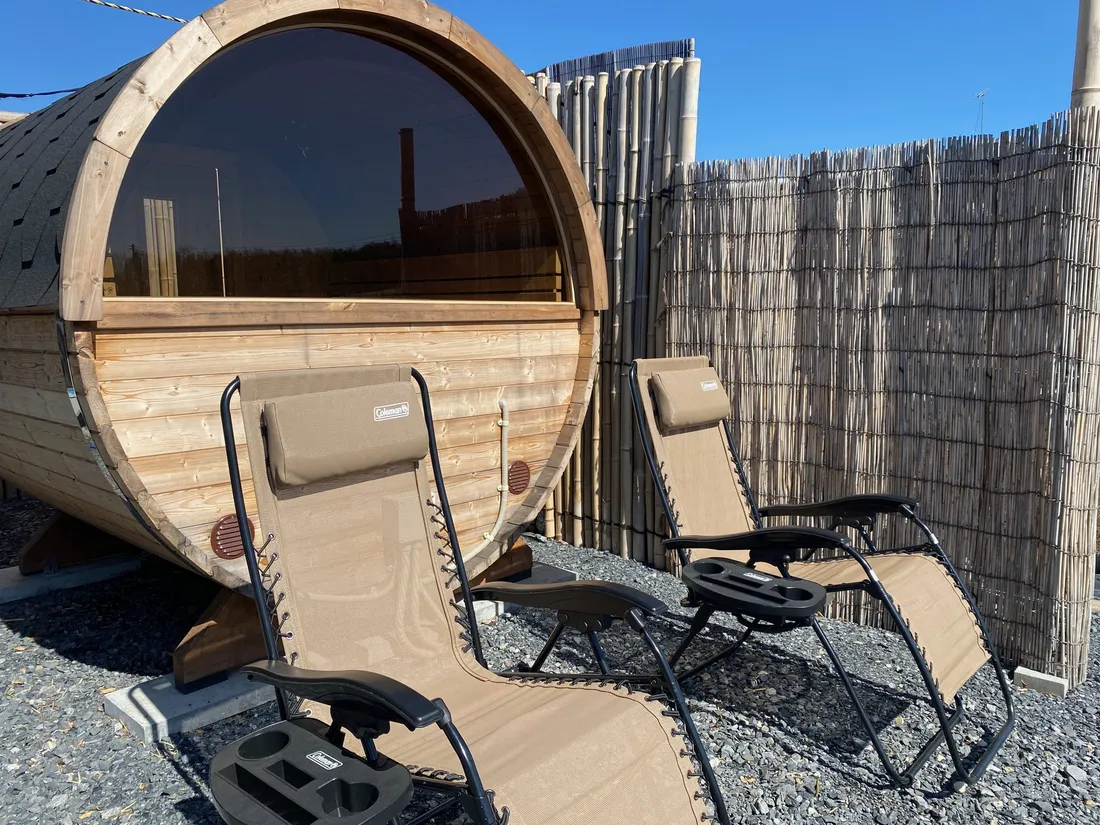
The short version: Finnish sauna purists have real, physics-based criticisms of barrel saunas — and they’re mostly right. I own a barrel anyway, three years and counting, and I’d buy it again. This is the article where I steelman the case against my own sauna, report what my actual measurements say, and explain the part of the value equation the physics debate leaves out. If you’re deciding on a barrel, read the criticism before you buy, not in the comments after.
How this article happened
I posted my sauna on r/Sauna. A Finnish commenter told me, in effect, that out of my professed love for Finnish and Estonian culture I had managed to buy a shape you see almost nowhere in Finland, with a heater no Finn would choose. The comment was downvoted; my reply — “my little barrel and I are very happy being wrong together” — got 26 upvotes and, apparently, became this website’s motto.
But here’s the thing: dunking on the tone is easy. The content of the criticism deserves better than a punchline. So I read the document that r/Sauna treats as scripture on this topic — Trumpkin’s Notes on Building a Sauna — plus the barrel-specific notes, and I’m going to represent the case fairly.
The case against barrels, stated properly
The Finnish framework starts from what’s sometimes called the First Law of Löyly: your feet should be above the stones. Heat stratifies — the good, steam-carrying air floats in the upper third of the room. A well-built Finnish sauna puts the entire bather, feet included, up in that zone, with tall ceilings and high benches. The head-to-toe temperature difference on your body should be small.
Barrels fail this framework in several ways:
- Low benches, low feet. The curved wall means benches sit low; your feet dangle down into the coldest layer of the room. Head cooking, ankles chilly — the classic barrel complaint.
- No upper bench. In a tall sauna you can climb toward the heat. In a barrel there’s nowhere to go.
- Ergonomics. The curve behind your back pushes your head and shoulders forward. Fine for lying down; genuinely less comfortable for sitting upright, especially for tall people.
- The economics changed. Barrels used to win on price. Cube-style kits now cost about the same, which removes the main historical reason to choose the shape.
I want to be clear: none of this is wrong. These are accurate descriptions of the physics and the geometry. Anyone selling you a barrel as “the same experience as a Finnish sauna, but cuter” is lying to you about the first half.
What my three years actually measure
First, full disclosure, because it changes how you should read every number below: my heater is a Tylö Pure 8kW, oversized for a 2m barrel (4–6kW is standard). I got it secondhand from a sauna facility — it was luck, not foresight.
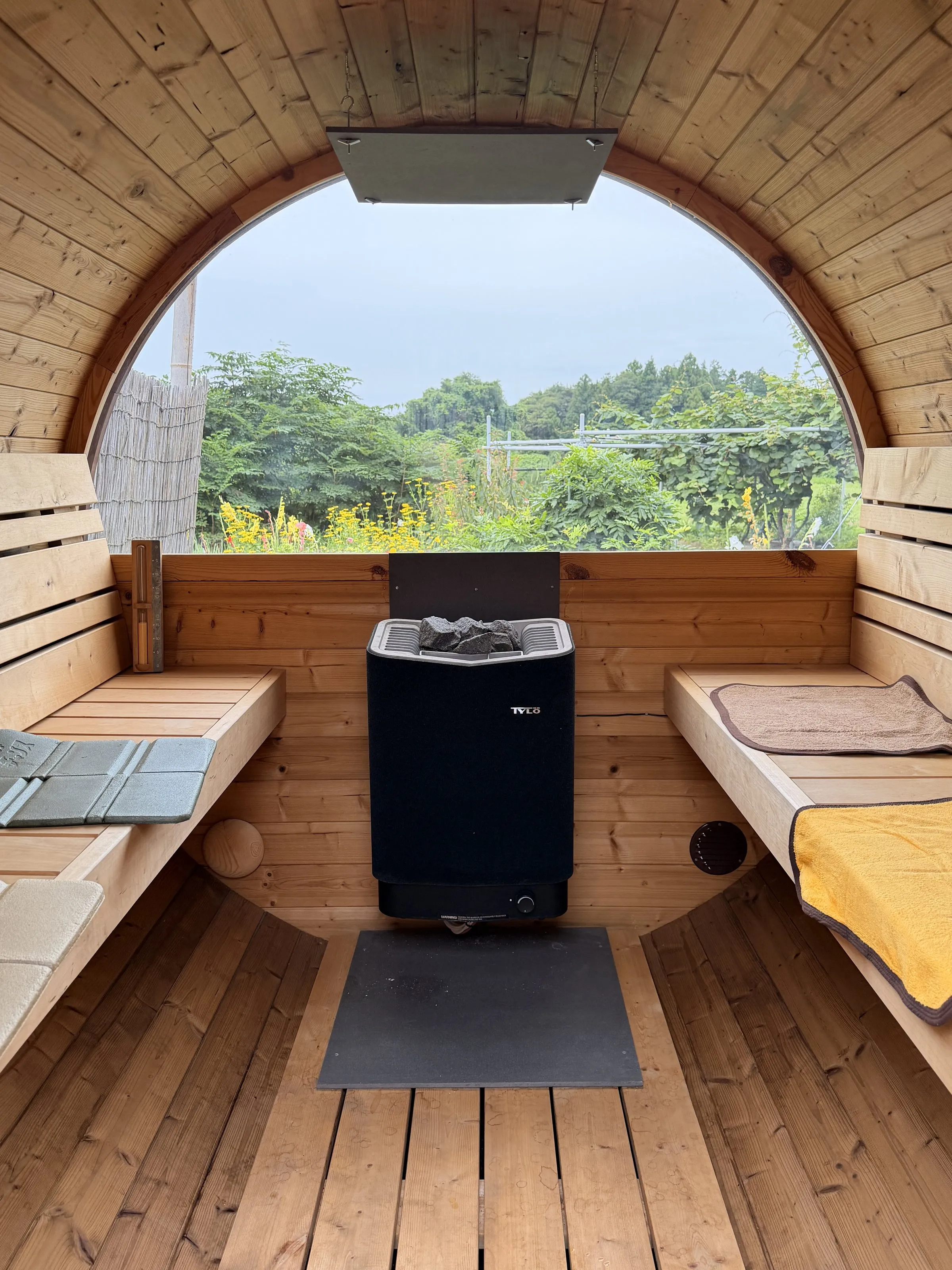
And yet. Here’s the testimony from my particular barrel — a 4-person Estonian-built Tesler with an electric Tylö Pure heater:
- 90°C (194°F) in about 20 minutes, summer. 25–30 in winter. Full data here.
- One 50ml ladle of löyly and sweat runs off my entire body — including, notably, my legs — within a couple of minutes. The purist critique says a small heater with few stones can’t deliver proper löyly. Mine delivers enough that nobody who has actually sat in it has ever complained about the steam. My heater is also mounted low, which a thoughtful critic once pointed out works with the barrel’s geometry rather than against it — the heat starts down where the “cold zone” would be.
- Stratification exists but doesn’t ruin anything. Are my ankles cooler than my face? Measurably, yes. Has it ever once shortened a session, dampened a totonou, or bothered a guest? Three years, dozens of guests: no.
The gap between “physically suboptimal” and “practically fine” turns out to be enormous. A barrel with a strong, well-placed heater and honest löyly is not the platonic Finnish sauna. It is, however, a genuinely hot, genuinely working sauna — and one owner-critic on Reddit who insists there’s no reason to buy a barrel admitted in the same thread that he owns one and uses it daily. I find that detail more informative than any spec sheet.
And here is why that disclosure matters more than it might seem. If an oversized heater is what makes my barrel perform well, then the purist critique and my experience are not actually in conflict — they’re the same finding, stated from opposite ends. A barrel with a weak heater is exactly the disappointing sauna the critics describe. A barrel with abundant power is not. The shape isn’t the whole story; the shape plus the power budget is.
Practical mitigations, from the owner community
If you have a barrel or are getting one, these close most of the gap:
- Buy more heater than the minimum — this is the whole ballgame. I’m living proof by accident: my 8kW unit is roughly double what a barrel this size usually ships with, and it is, I now believe, the single biggest reason my experience diverges from the critics’. If a barrel package offers 4kW and 6kW options, this is not the place to save money.
- Mount the heater low so the heat column starts beneath bench level.
- Sit at the ends, not the sides. The wall is nearly vertical at the barrel’s ends — no forward curve pushing your head. Add a movable backrest and put your feet up on the bench, and you’ve raised your whole body toward the warm layer. (Fellow owners swear by this; I’m running my own tests and will update this section with results.)
- Use water. Löyly is not optional equipment in a barrel. It’s the mechanism that makes the whole room feel alive.
The part of the value equation physics can’t see
Now the part I actually want to say.
The purist framework optimizes one variable: löyly quality. It’s a beautiful variable to optimize. But a sauna you own is not a physics experiment — it’s an object in your life, and objects in your life live or die by whether you keep coming back to them.
A Finnish commenter in my thread mentioned that store-bought sauna kits are rumored to have very high abandonment rates — average use measured in a couple of years before they become expensive storage sheds. I believe it. And I’d point out that no amount of löyly optimization fixes that, because abandonment isn’t a thermodynamics problem. It’s a relationship problem.
Here is what my thermodynamically incorrect barrel has going for it, three years in and still in active use:
- It’s kawaii. I’m Japanese; I’m allowed to invoke this as a technical term. The round shape is lovable. I feel a small lift every time I see it sitting in the field, and my guests photograph it before they’ve even been inside. In Japanese design culture we take seriously the idea that cuteness is a retention feature — you maintain what you love looking at. My family repainted this thing by hand. You don’t do that for a shed.
- It’s a social machine. The window, the shape, the campfire-adjacent scale of it — friends gather here. Lawyers, a pro athlete, tattooed friends locked out of Japan’s public baths. The full story.
- It heats in 20 minutes, which is the difference between “I’ll sauna tonight” and “maybe this weekend.”
- It has shrugged off three Japanese rainy seasons and several typhoons with a maintenance record of one LED bulb. More on that here.
None of that appears in the löyly equations. All of it determines whether a sauna is alive in year three.
Who should NOT buy a barrel
Honesty cuts both ways:
- If you’re optimizing purely for löyly physics and have the space, budget, and patience to build a proper tall-ceiling sauna with high benches — build that. It is better at being a sauna.
- If you’re tall and plan to sit upright on the side benches for long sessions, sit in a barrel before buying.
- If your budget makes a barrel and a cube kit equivalent, take the comparison seriously — the cube probably wins on pure sauna performance. (Full comparison coming: barrel vs cabin.)
- If you’re buying a barrel package with a minimum-spec heater and can’t upgrade it — reconsider. You will likely get the exact experience the critics warn about.
Verdict
The Finns are right about the physics. I’m right about my Tuesday evenings. Both things are true, and pretending otherwise — in either direction — is how you end up with a $10,000 purchase you resent.
Buy the barrel with open eyes, give it a strong heater and real löyly, sit at the ends, and love the ridiculous round shape without apology. Or build the tall Finnish room and invite me over — I’ll bring the Oropo.
Until then, my little barrel and I remain very happy being wrong together.